Homicide charges are the most serious criminal allegations in Texas. When someone is accused of causing another person’s death, the legal system responds with extremely high stakes, aggressive prosecution, and life-changing consequences.
But not all homicide charges are the same. Texas law recognizes multiple categories of homicide, each with its own legal definitions, mental state requirements, and potential penalties. Understanding these differences is essential for anyone facing allegations or trying to make sense of the criminal justice process.
This guide breaks down the primary types of homicide charges in Texas, how they are defined under state law, why the accused person’s intent matters, and what defenses may apply.
The defense team at Fulgham Hampton Criminal Defense Attorneys brings more than 105 years of combined criminal law experience, handling serious felony charges throughout Tarrant County, Fort Worth, Arlington, Bedford, Southlake, and Weatherford. This overview explains the framework behind homicide cases and what each charge truly means.
Reach out to an experienced criminal defense lawyer today to protect your rights and take the first step toward a strong defense.
Key Takeaways
- Texas recognizes several types of homicide: murder, capital murder, manslaughter, intoxication manslaughter, and criminally negligent homicide.
- The accused person’s mental state — intentional, knowing, reckless, or negligent — determines how a charge is classified.
- Penalties range from state jail felonies to life imprisonment without parole.
- Enhancements may apply based on circumstances such as victims who are peace officers, multiple deaths, or certain felony involvement.
- Defenses vary depending on the facts and may include self-defense, sudden passion, accident, or lack of intent.
- Every homicide case is unique, and the classification depends on evidence, intent, and statutory definitions.
Murder Under Texas Law
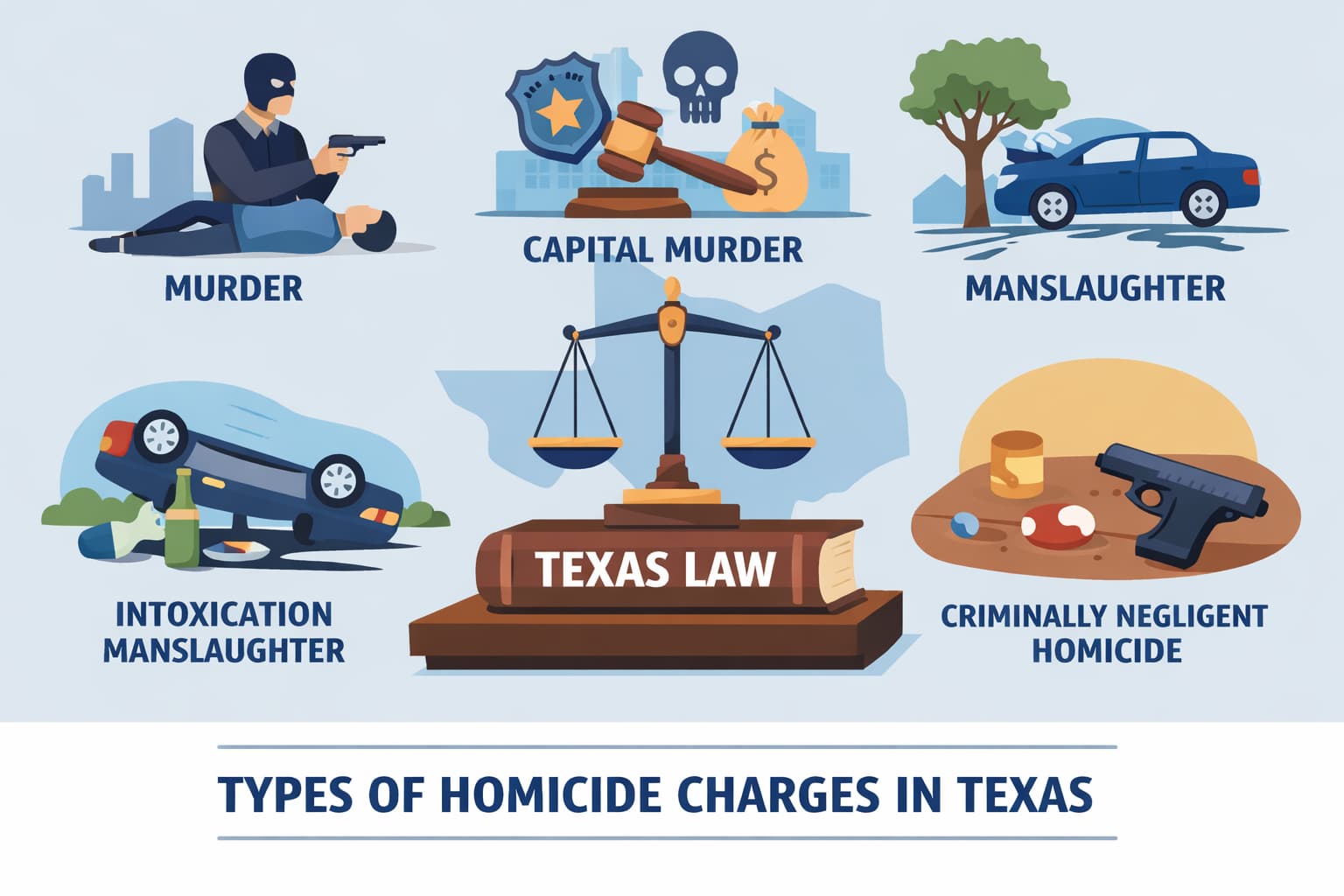
“Murder” is one of the most commonly misunderstood homicide charges. Under Texas Penal Code § 19.02, murder occurs when a person:
- Intentionally or knowingly causes the death of another person
- Intends to cause serious bodily injury and commits an act clearly dangerous to human life that results in death
- Causes someone’s death while committing or attempting to commit a felony (other than manslaughter) under the felony murder rule
The first two definitions focus heavily on intent. Prosecutors must show the accused acted knowingly or intentionally. The third definition, felony murder, does not require intent to kill; the death only needs to occur during the commission of a qualifying felony.
Murder is generally a first-degree felony, punishable by 5 to 99 years or life in prison and up to a $10,000 fine. However, murder can be reduced to a second-degree felony if the accused acted under “sudden passion,” an emotional state arising from adequate provocation.
Fulgham Hampton Criminal Defense Attorneys analyzes whether sudden passion, lack of intent, accident, or self-defense applies to challenge the prosecution’s theory.
Capital Murder: The Most Serious Charge in Texas
Capital murder represents the highest level of homicide charge in Texas. Under Texas Penal Code § 19.03, a murder becomes capital murder when certain aggravating factors are present. Some examples include:
- Killing a police officer or firefighter acting in official duty
- Murder during a kidnapping, robbery, burglary, or aggravated sexual assault
- Murder for hire (or hiring another to commit murder)
- Killing more than one person during the same criminal episode
- Killing a child under 10 years old
- Killing a judge or justice in retaliation for official actions
Capital murder cases are prosecuted aggressively at both the state and sometimes federal level. A conviction carries life imprisonment without parole, and in some circumstances, prosecutors may seek the death penalty.
Because of the severity of these cases, defense strategy focuses on scrutinizing every piece of evidence, challenging aggravating factors, and evaluating whether the state can prove the specific statutory elements required for capital murder.
The defense team approach at Fulgham Hampton Criminal Defense Attorneys ensures a thorough analysis from every angle.
Manslaughter: A Homicide Caused by Recklessness
Manslaughter applies when someone causes another person’s death through reckless conduct, not intentional or knowing behavior. Defined under Texas Penal Code § 19.04, a person acts recklessly when they disregard a substantial and unjustifiable risk that their actions could cause death.
Examples might include:
- Discharging a firearm in a crowded area
- Driving at extreme speeds during dangerous weather
- Handling a weapon irresponsibly
- Engaging in risky physical behavior without regard for safety
Manslaughter is a second-degree felony, punishable by 2 to 20 years in prison.
This charge is different from an intentional homicide because it centers on conduct that was dangerous and irresponsible, not deliberate.
A strong defense may include accident, lack of recklessness, intervening causes, or challenging the prosecution’s interpretation of the accused person’s state of mind. Fulgham Hampton Criminal Defense Attorneys evaluates whether the evidence truly supports a reckless mental state or whether prosecutors overcharged the case.
Intoxication Manslaughter: Causing Death While Intoxicated
Intoxication manslaughter is a unique Texas offense that applies when a person operates a car, boat, aircraft, or amusement ride while intoxicated and causes someone’s death. Under Texas Penal Code § 49.08, the state does not need to prove intent — only intoxication and causation.
Intoxication manslaughter is typically a second-degree felony, but penalties increase if the victim was a firefighter, police officer, or emergency medical worker.
Potential consequences include:
- 2 to 20 years in prison
- Fines up to $10,000
- Mandatory license suspension
- Long-term supervised probation in some cases
Defenses may include challenging the traffic stop, questioning the accuracy of breath or blood testing, proving the intoxication did not cause the accident, or identifying mechanical or environmental factors that contributed to the crash.
Because Texas uses DWI as the legal term, intoxication manslaughter charges require attorneys familiar with both homicide statutes and intoxication-related defenses — a combination that Fulgham Hampton Criminal Defense Attorneys routinely handles as a team.
Criminally Negligent Homicide: The Lowest-Level Homicide Charge
Criminally negligent homicide occurs when a person causes death through criminal negligence, which is a lower mental state than recklessness. Under Texas Penal Code § 19.05, a person is criminally negligent when they should have been aware of a substantial and unjustifiable risk, but failed to recognize it.
Examples may include:
- Leaving a dangerous weapon accessible to a child
- Failing to secure hazardous materials
- Negligent handling of heavy equipment
- Extreme carelessness that creates a foreseeable risk of death
Criminally negligent homicide is a state jail felony, punishable by 180 days to 2 years in a state jail facility.
The challenge in these cases often revolves around proving the accused “should have known” about the risk. The defense team may argue that the act was accidental, unforeseeable, or influenced by circumstances beyond the defendant’s control.
Felony Murder Rule in Texas
The felony murder rule is one of the most important — and misunderstood — aspects of Texas homicide law. Under this rule, a person may be charged with murder even if they never intended to kill anyone. Instead, Texas Penal Code § 19.02(b)(3) allows prosecutors to charge murder if someone dies during the commission or attempted commission of a felony other than manslaughter.
This means that if a death occurs during a robbery, burglary, kidnapping, or other qualifying felony, the accused may face first-degree murder charges even if the death was an accident or caused by a co-defendant. The rationale behind the rule is that certain felonies are inherently dangerous, and anyone participating in them assumes the risk of unintended consequences.
Because felony murder does not require intent, prosecutors often use it when evidence of purposeful killing is unclear. The defense team at Fulgham Hampton Criminal Defense Attorneys evaluates whether the underlying felony truly applies, whether causation is clear, and whether the death was sufficiently connected to the alleged felony. Many felony murder charges hinge on technical details, timing, and the conduct of other individuals involved. A strong defense requires examining each of these elements carefully.
Defenses in Texas Homicide Cases
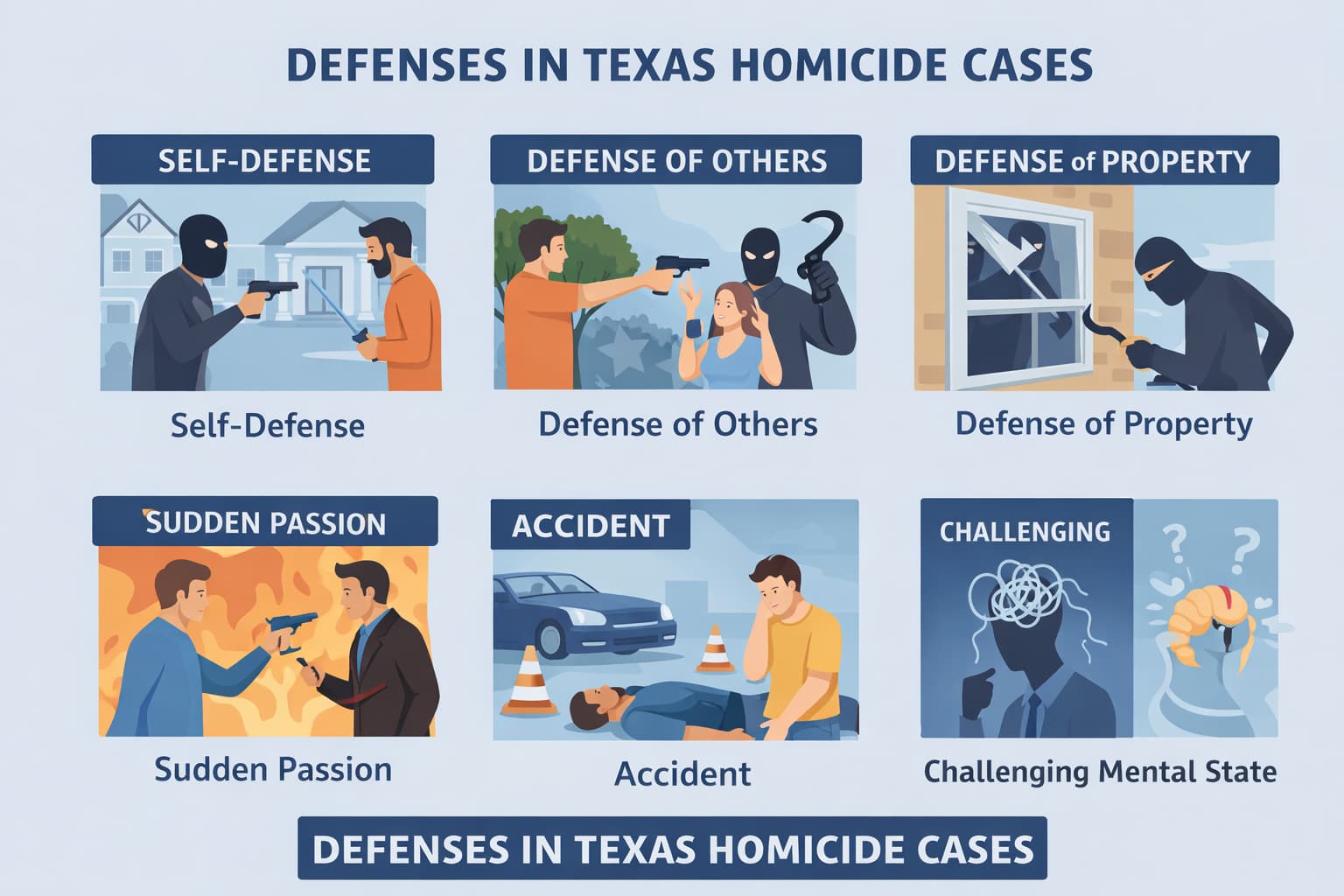
Homicide charges are serious, but they do not automatically result in a conviction. Texas law allows several defenses depending on the facts of the case. Some of the most important include:
Self-Defense
One of the most common defenses, self-defense applies when a person reasonably believes deadly force is immediately necessary to prevent death, serious bodily injury, or certain violent felonies.
Defense of Others
Texas extends protective rights to individuals defending someone else from deadly harm.
Defense of Property
In limited circumstances, Texas law allows deadly force to stop certain violent property crimes.
Sudden Passion
A murder charge may be reduced to a second-degree felony if the accused acted under sudden passion arising from adequate provocation.
Accident
If the death was truly accidental and lacked intent, recklessness, or negligence, charges may be reduced or dismissed.
Challenging Causation
Prosecutors must prove that the accused person’s actions directly caused the death.
Challenging Mental State
Many homicide charges hinge on whether conduct was intentional, knowing, reckless, or negligent.
The team approach used by Fulgham Hampton Criminal Defense Attorneys ensures that every possible defense, factual question, and legal angle is evaluated collaboratively.
How Intent Affects the Level of Homicide Charges
Texas separates homicide charges based on the accused person’s mental state, which refers to what the person intended, knew, or should have known at the time of the incident. Understanding these distinctions is essential:
- Intentional: A purposeful killing, leading to a murder or capital murder charge.
- Knowing: The accused knew their actions were almost certain to cause death or serious injury.
- Reckless: The person was aware of a substantial risk but chose to disregard it. This applies to manslaughter.
- Criminal Negligence: The person should have recognized the risk but failed to. This applies to criminally negligent homicide.
- Strict Liability (Intoxication Manslaughter): Intent is irrelevant when intoxication causes death.
Proving the correct mental state is one of the most contested aspects of homicide cases. The defense team works to show either a lack of intent, an absence of knowledge, or a misunderstanding of circumstances to reduce or challenge the charges.
Penalties and Sentencing Factors in Texas Homicide Cases
Homicide penalties in Texas vary widely depending on the charge, prior criminal history, aggravating factors, and the presence of any enhancements. Potential penalties include:
- Capital Murder: Life without parole, or the death penalty in eligible cases.
- Murder (1st Degree): 5 to 99 years or life in prison.
- Murder (2nd Degree with sudden passion): 2 to 20 years in prison.
- Manslaughter: 2 to 20 years in prison.
- Intoxication Manslaughter: 2 to 20 years in prison, with enhancements in certain circumstances.
- Criminally Negligent Homicide: 180 days to 2 years in a state jail facility.
Sentencing may also depend on:
- Use of a deadly weapon
- Prior felony convictions
- Vulnerability of the victim
- Whether probation is legally permissible
- Whether the accused cooperated with law enforcement
- Whether mitigating circumstances (such as provocation or accident) apply
Because stakes are so high, every detail matters. Fulgham Hampton Criminal Defense Attorneys incorporates mitigation strategies, expert testimony, and deep statutory knowledge into every homicide defense.
How Fulgham Hampton Criminal Defense Attorneys Build a Homicide Defense
Homicide cases require extensive investigation, legal strategy, and collaboration. Fulgham Hampton Criminal Defense Attorneys uses a team-driven approach, combining more than 105 years of collective criminal defense experience.
A thorough homicide defense may include:
- Reviewing police reports and forensic evidence
- Challenging witness credibility and statements
- Working with forensic, medical, and ballistic experts
- Analyzing cell phone data, video footage, and electronic records
- Challenging unlawful searches or constitutional violations
- Examining the mental state element with psychological experts
- Pursuing alternative explanations for the incident
- Negotiating charge reductions when appropriate
The firm’s collaborative model allows multiple attorneys to contribute insights, legal research, and strategic considerations. This ensures no detail is missed and that the defense reflects the full strength of a seasoned criminal team.
Contact Fulgham Hampton Criminal Defense Attorneys
Homicide charges represent the most serious accusations a person can face in Texas. The consequences are life-changing, and the legal system treats these cases with intense scrutiny. Anyone accused of causing a death needs a defense team with deep experience, strong strategic insight, and the ability to challenge the prosecution from every angle.
Fulgham Hampton Criminal Defense Attorneys brings over 105 years of combined criminal defense experience, serving Fort Worth, Tarrant County, Arlington, Southlake, Bedford, Weatherford, and surrounding communities.
The firm’s team-based approach ensures every case benefits from multiple perspectives, extensive legal knowledge, and rigorous investigation.
To discuss your situation and explore your defense options, contact Fulgham Hampton Criminal Defense Attorneys at (817) 877-3030.
About The Author:
Brandon Fulgham has an in-depth understanding of both Texas law and Texans themselves. Before practicing law here, he received his undergraduate degree from TCU and his law degree from South Texas College of Law in Houston. After graduation, he worked in District Attorneys’ offices as a prosecutor. Now, he uses that knowledge to anticipate opposing counsel’s arguments and protect the rights of people in and around Fort Worth. His work has been recognized by Expertise (Best Criminal Defense Lawyers in Forth Worth and Best DUI Lawyers in Fort Worth, both 2020), Fort Worth Magazine, and The National Trial Lawyers, just to name a few.
Author's Bio